Guide · Free template · For schedulers and shift workers
The DuPont schedule: a hard month, then seven days off
The DuPont schedule is a 28-day rotation in which four teams cover a workplace around the clock in 12-hour shifts. Each team works four nights, three off, three days, one off, three nights, three off, four days, then has seven consecutive days off. That is fourteen shifts in four weeks, averaging 42 hours a week.
Free · No account · Just your email
Or skip the spreadsheet: run it as a live schedule, free for 14 days →
Where can I download a DuPont schedule template?
Here: the buttons below. Enter your email address once and the file downloads straight away, with a copy to your inbox. No account, no card.
The spreadsheet opens in Excel, Google Sheets, LibreOffice or Numbers, and its totals are live formulas that recalculate as you type. The PDF is laid out landscape, ready to print for a wall. Also available as a CSV or a printable web page.
What is in it
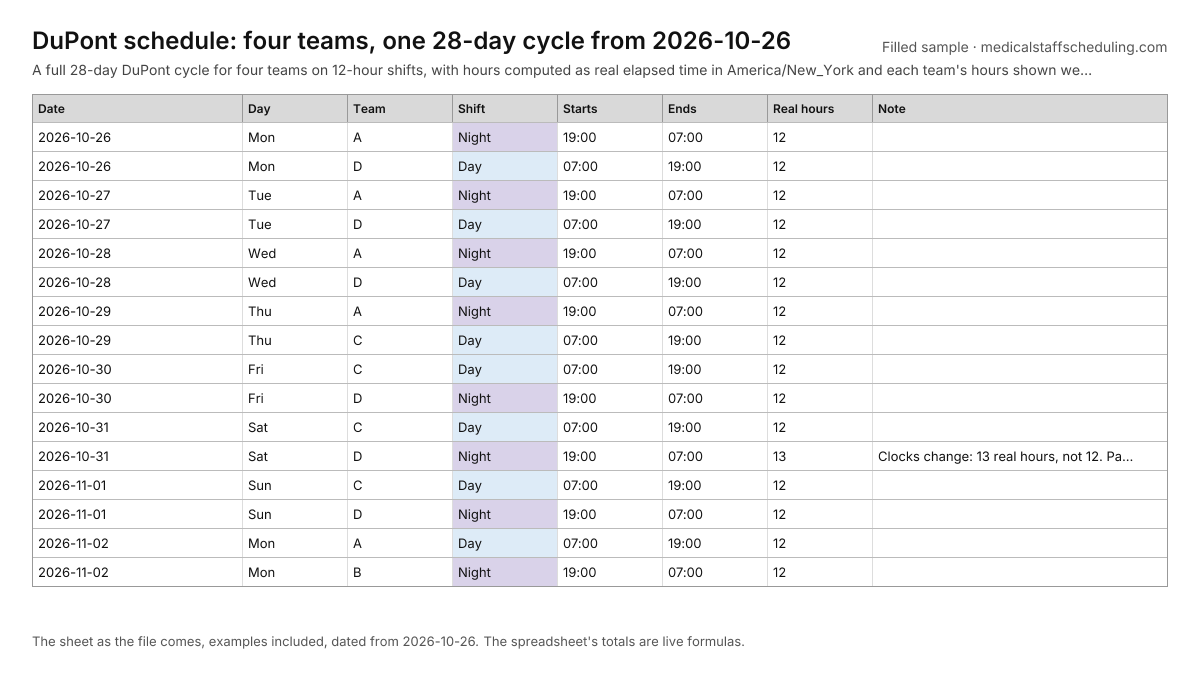
- One full 28-day DuPont cycle for teams A to D on the dates you pick, with every day and night shift laid out by date.
- Hours computed as real elapsed time, so the night the clocks go back reads 13 hours and the night they go forward reads 11, with a note on the row.
- Each team's real hours week by week (48, 72, 48 and 0 on an ordinary cycle), with any week over 60 shaded, plus totals per team.
- A coverage check on every date that says "No: check" in red if a date does not have exactly one day team and one night team, and recounts when you swap a team.
- A Team members block to write who is in each team, a team dropdown on every row, and a landscape PDF for the wall.
At a glance
- The DuPont schedule is a four-week cycle of 12-hour shifts for four teams (A, B, C and D): four nights, three off, three days, one off, three nights, three off, four days, then seven days off in a row.
- The four teams run the same cycle seven days apart, so on any date one team works the day, one works the night and two are off. Coverage is continuous with no overlap and no gap.
- Every team works fourteen shifts per 28 days, an average of 42 hours a week. The weeks themselves are 48, 72, 48 and 0 hours, and the 72-hour week is the one that decides whether DuPont works for you.
- Its selling point is the seven-day break every cycle. Its cost is that every team rotates between days and nights, including a stretch of four nights and a three-day turnaround onto days.
- In healthcare it suits units that already run 12-hour shifts and can form four complete teams with the right skill mix in each; it fits poorly where overtime is counted by the week or continuity with the same patients matters most.
What is the DuPont schedule?
The DuPont schedule is a four-team, 28-day rotation of 12-hour shifts that keeps a workplace staffed every hour of every day, and gives every team seven consecutive days off once per cycle.
It takes its name from the chemical company DuPont, which ran it in plants that could not stop, and it spread from there to other continuous operations: refineries, utilities, police and fire services, and hospital departments that staff in twelve-hour shifts. The shape is the same wherever it is used. Covering 24 hours needs two 12-hour shifts a day; covering seven days a week without anyone working every day needs those shifts shared among enough people; four teams is the smallest number that does it with every team on the same pattern.
Each team works the identical 28-day cycle, started seven days after the team before it. Team A starts on day one, team B a week later, C a week after that and D a week after that. Because the cycle is exactly four weeks long and the teams are offset by exactly one week, every date has one team on the day shift, one on the night shift and two at home, and no date has two teams on the same shift.
How does the DuPont 4-week cycle work?
One team's 28 days run: four nights, three off, three days, one off, three nights, three off, four days, seven off. On the 29th day the cycle starts again with four nights.
Laid out as four weeks from the first night, one team's month looks like this. Week one: nights on days 1 to 4, then off for three days. Week two: three day shifts, one day off, three night shifts. Week three: three days off, then four day shifts. Week four: off, all seven days. The other three teams are doing the same thing, each one week further along, which is why the template on this page shows four teams on four different weeks of the same cycle on any given date.
Two features follow from that shape. The pattern rotates by design: every team works days and nights in every cycle, so the nights are shared equally rather than given to a permanent night team. And the working days are concentrated: fourteen shifts are packed into three weeks so that the fourth week can be empty.
Who works on a given day? Teams A, B, C and D
On day one of the cycle, team A starts its four nights. Team D, one week into its own cycle, works the first of its three day shifts. Team B is in its seven days off, and team C is in the three days off before its four day shifts. A week later B starts its nights and A moves into its week of days and nights. The rotation guarantees exactly one team per shift on every date, and the template's coverage check counts it date by date so a swap that breaks it shows up in red.
How many hours a week is the DuPont schedule?
42 on average, and almost never 42 in an actual week. Fourteen 12-hour shifts in 28 days is 168 hours, which is 42 a week. Counted Monday to Sunday from the start of the cycle, one team's weeks are 48, 72, 48 and 0 hours. The 72-hour week has six shifts in seven days: three days, one off, then three nights.
What are the pros and cons of the DuPont schedule in healthcare?
The case for it is the seven-day break and a fair share of nights; the case against it is the 72-hour week, the turnarounds between days and nights, and what four rotating teams do to continuity of care.
The pattern itself is indifferent to whether the workplace is a refinery or a ward. What changes in a hospital is what the rotation has to carry: a skill mix on every shift, patients who notice who their nurse is, and a workforce that is often part-time. Those are the places DuPont is either a good fit or a poor one.
The advantages
A full week off every four weeks, which no amount of scattered rest days adds up to, and which staff consistently cite as the reason they want the pattern. Only fourteen shifts a month. Nights shared equally across all four teams instead of concentrated on a permanent night team. A schedule that is known years ahead, because it repeats exactly every 28 days. And it uses the 07:00 to 19:00 and 19:00 to 07:00 shifts many inpatient units already run.
The disadvantages
The 72-hour week: six 12-hour shifts in seven days is tiring at the end of it, and if your overtime is counted by the week, it triggers overtime every cycle; counted over fourteen days instead, the first fortnight is 120 hours and the second 48. Four consecutive nights, then a three-day turnaround onto days, and in the second week a single day off between three days and three nights: every team keeps re-adjusting its sleep, every cycle. A nurse who is away for seven days misses a full week of her patients. And the pattern assumes full-time members of four complete teams, so part-time staff, self-scheduling and individual requests all have to be fitted around it.
What it takes to run it on a unit
Four teams, each able to staff a shift unaided: enough registered nurses for the ratio, a charge nurse, and the competencies the unit needs on nights as well as days. In practice that is four times your minimum per-shift staffing, plus cover for leave and sickness, because a short team is short for every shift it works. A unit that can only fill three teams is not running DuPont; it is running a different pattern with somebody permanently on call to plug the gap.
DuPont or Pitman: which 12-hour rotation should I use?
Pitman if predictable alternating weekends and short runs of work matter most; DuPont if a whole week off matters most and the team can absorb a 72-hour week to get it.
Both use four teams, both use 12-hour shifts and both average 42 hours a week, because 168 hours of coverage shared by four teams is 42 each whatever the shape. The difference is how the same hours are arranged. Pitman repeats every fourteen days, never asks for more than three shifts in a row, gives every team a full weekend off every other week, and is often run fixed, with permanent day and night teams. Its weeks swing between 36 and 48 hours. DuPont repeats every 28 days, packs the work into three weeks, rotates every team through nights, and pays for it with the empty fourth week.
If you are not running 12-hour shifts, neither applies: the four-team pattern for 8-hour shifts is the Southern Swing, which rotates through days, evenings and nights. Whichever you consider, generate it on your own dates and show it to the people who will work it before you decide. The objections tell you which cost your unit will not pay.
What a DuPont schedule cannot do for you
Fill itself. The pattern is a correct shape; whether it is a safe roster depends entirely on the people you put into it.
The rotation does not know who is in team C, whether every one of them holds a current licence for the unit, whether a nurse in her 72-hour week is also picking up an extra shift somewhere else, or whether two of the team booked the same seven days off. It does not know what its nights are worth in hours either: a 19:00 to 07:00 night is 13 real hours the night the clocks go back and 11 the night they go forward, and a payroll that multiplies twelve by fourteen shorts somebody twice a year.
MedAligna puts named people into a rotation like this one, checks credentials, rest and weekly hours before each shift is saved rather than after, and computes hours on real elapsed time across the clocks change.
Generate DuPont with your own team names
The rotating shift schedule generator opens with DuPont selected: pick the date your first team starts its four nights, type your team names over A to D, and it lays the cycle onto as many weeks as you need, in the browser, with no account.
Questions people actually ask
- How many hours a week is the DuPont schedule?
- 42 on average: fourteen 12-hour shifts every 28 days is 168 hours, or 42 a week. The actual weeks are 48, 72, 48 and 0 hours, counted from the start of a team's cycle. Check how your overtime is counted before adopting it, because the 72-hour week comes round every four weeks for every team.
- How many days off do you get on the DuPont schedule?
- Fourteen days off in every 28, the same number as days worked. They come as three blocks: three days, then three days, then seven consecutive days at the end of the cycle, plus a single day between the day shifts and the night shifts in the second week.
- Is the DuPont schedule the same as a 4-on 3-off schedule?
- No, though it starts like one. A 4-on 3-off schedule repeats the same four shifts and three days off every week. DuPont only begins with four nights and three off; the rest of its 28 days are three days, one off, three nights, three off, four days and seven off, so no two weeks are the same.
- How many staff do you need for a DuPont schedule?
- Four teams, each able to cover a shift on its own, so at least four times your minimum staffing per shift, plus relief for leave and sickness. Every team needs the full skill mix for nights as well as days, because every team works both.
- Does the DuPont schedule work with 8-hour shifts?
- No. DuPont is defined on 12-hour shifts: two shifts a day, one team on each. The four-team rotation for three 8-hour shifts a day is the Southern Swing, which the 24/7 shift schedule template lays out.
- Can I generate a DuPont schedule on my own dates?
- Yes, two ways, both free and without an account. The template on this page lays one full cycle onto the dates you pick, as Excel, PDF or CSV. The rotating shift schedule generator, linked on this page with DuPont already selected, lays it onto as many weeks as you like in the browser with your own team names.
Related
The pattern is the easy half. The people
MedAligna puts real staff into a rotation and checks each one: credentials, rest, weekly hours, and hours across the clocks change. Fourteen days free, no card.